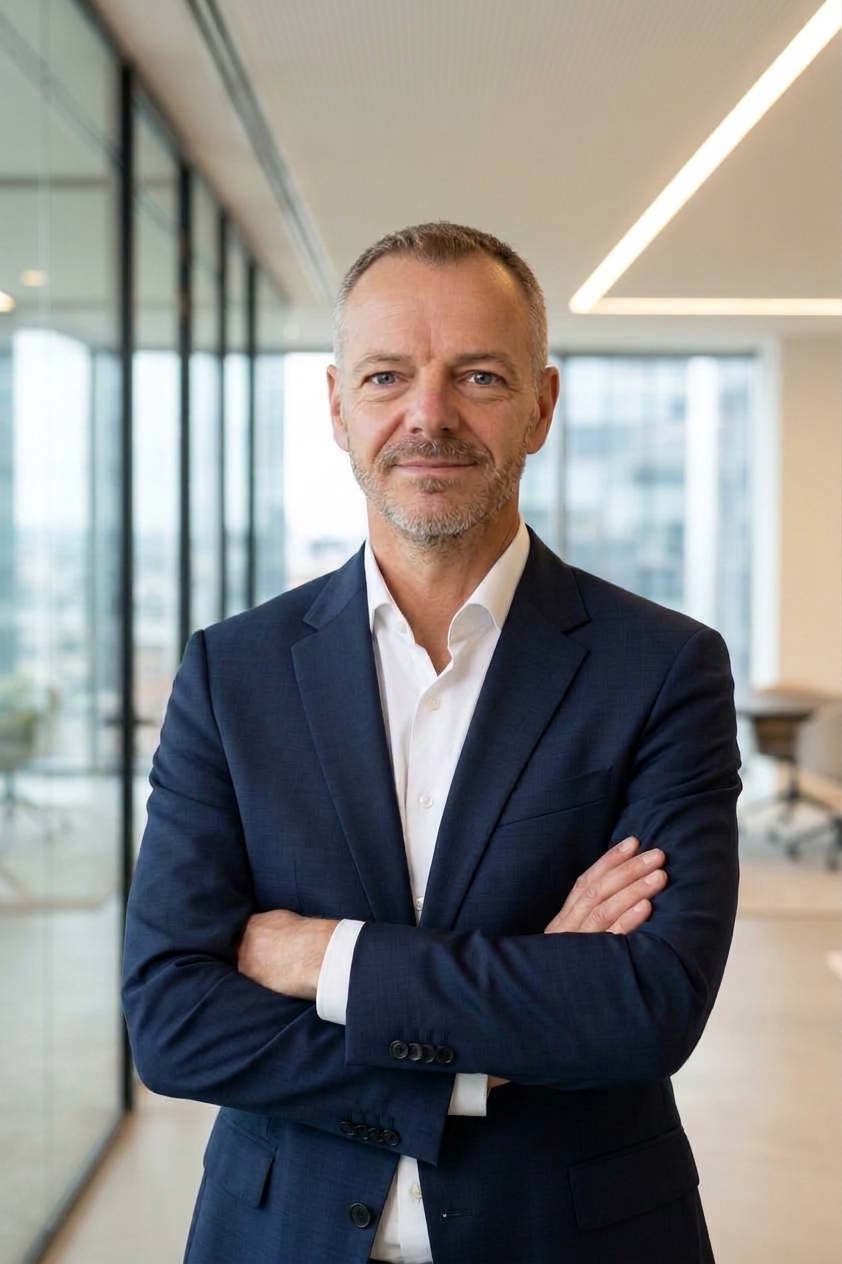
John van Lith · Interim Enterprise & System Architect

True architecture endures beyond those who create it.

I work where strategy meets the systems that have to carry it: the landscape as it actually is, the decisions that shape it, and the organisation that has to live with the result. Thirty years in energy, aviation, maritime and public-sector environments have taught me that the hard part is rarely the target picture.

Profile

I help organisations make complex digital transformations manageable.

From enterprise and system architecture to process redesign, data governance and system integration.

Most of my work starts with a question that sounds technical and is not: why does this process take three weeks when everyone agrees it should take three days? The answer is usually spread across systems, contracts, budgets and habits. Making that visible is the first job.

I then translate the findings into a small number of decisions that someone must own: which system holds the truth, which capability is bought and which is built, what may run automatically and what must wait for a person. A target architecture is only useful if these decisions are explicit, dated and reversible when the facts change.

Over the last two years the same questions have reached AI. Agents can analyse, classify and propose, but they can also act on a system that was never designed for them. My focus is on where autonomy should stop, how each step is validated, and how every outcome can be traced back to the input and the rule behind it.

John van Lith
Interim Enterprise & System Architect

John van Lith

Enterprise and system architecture, process redesign, data governance and system integration.
Working together

Architecture is a sequence of decisions, not a document.

  • Thirty years across energy, aviation, maritime and the public sector
  • Every architecture decision has an owner, a date and a reason
  • AI inside the process, with a human gate where it matters
  • Transitions run alongside the existing system until the new one has proven itself

Principles

Five things I hold to on every engagement.

  1. 01
    Architecture is a set of owned decisions.Each decision has an owner, a date and a reason that still makes sense after the person who made it has left.
  2. 02
    Entropy is the default.Systems drift toward complexity unless someone is responsible for resisting it. Architecture governance is that resistance, applied at procurement and change, not after go-live.
  3. 03
    Integrate through contracts, not connections.Point-to-point links are cheap to build and expensive to own. Clear capability boundaries and data contracts make change survivable.
  4. 04
    Autonomy is granted per decision.An agent may classify and propose. A decision with financial, legal or status consequence keeps a human gate, and every action leaves a trace.
  5. 05
    Transitions run alongside what exists.The old system serves the business until the new one has proven itself. A definition of done per plateau is the only honest measure of progress.
Perspectives

Three arguments I return to with clients.

The diagram is not the architecture.

A target picture makes a programme feel finished. It is not. The architecture is what happens when the picture meets budget cycles, contracts, legacy data and the people who were not in the workshop. If the diagram cannot survive those, it was a presentation, not a design. I ask early what will be different in six months, and who will notice.

AI needs a process, not a prompt.

A model that answers well in a demo can still fail in production for reasons that have nothing to do with the model: no clear input contract, no check on the output, no path for a person to override it, no record of what was decided. Putting an agent into a process forces the organisation to define those things. That is useful work, even if the agent turns out to be the smallest part.

Procurement is where architecture is won or lost.

Once a market product is selected, its shape is mostly fixed. Architecture therefore belongs in the tender, not after it. Requirements for integration, data ownership, exit options and observability should be written as conditions, not wishes. A product that cannot meet them as a black box should not be bought, however good the demo.

Approach

Four moves that keep the lights on.

I.

Diagnose

Map the current landscape, its entropy and its technical debt. Separate what the business needs from what IT can deliver today.

II.

Architect

Define the target architecture, its principles and integration patterns. Validate them against sector reference models and the people who must own them.

III.

Transition

Migrate in phases with the Strangler Fig pattern. Build the new around the old, with explicit go/no-go criteria per plateau.

IV.

Embed

Transfer capability into the organisation. Documented decisions, teams that run on their own, and a result that outlasts the engagement.

AI Orchestration

Agents inside the process, not around it.

An AI step is only useful when it sits inside a process that the organisation understands, controls and can audit. I design AI as a step in a flow, with defined inputs, validated outputs and a clear point where a person decides.

AI ORCHESTRATION PROCESS ORCHESTRATION Flows Human tasks Triggers Retries & timeouts Parallel branches AGENT LAYER Analysis Planning Tool use Prompt registry Context & memory GOVERNANCE & QUALITY Guardrails Schema checks Business rules Ontology Confidence & fallback Access control Observability Auditability Systems of record Integration layer & APIs Foundation models

One orchestration layer over systems of record, models and people. Flows and agents run inside governance and quality checks, and every step is observable and auditable.

Process Design

Processes you can read, discuss and run.

Business and IT should be looking at the same picture. I model processes visually in BPMN, connect them to the architecture in ArchiMate, and make sure the diagram is the same thing that runs in production.

Process modelling in BPMN

Gateways, approvals, escalation paths and failure routes, drawn so that business owners can validate them without reading code.

  • Happy path and exception paths modelled explicitly
  • Human tasks with a named owner and a clear outcome
  • Process maps linked to APQC and value streams

Process to architecture

A process is only useful if the systems behind it are visible. I connect BPMN processes to application and data components in the architecture model.

  • Business, application and data layers in one model
  • Bounded contexts that match how the organisation works
  • Integration points documented, not improvised

Orchestration with flows

Flows that call systems, run AI steps and wait for people. Designed for reuse, versioned, and deployable through a controlled release process.

  • Integration through a controlled API layer, not point-to-point
  • Validation of every incoming request against a data contract
  • Private triggers, secrets kept out of the flow logic

Change without big bang

New processes run next to the old ones and take over step by step. Each plateau has a definition of done before the next one starts.

  • Proof of concept as a vertical slice with success criteria
  • Rollback paths designed up front
  • Operations and ownership handed over to the team
Experience

Thirty years of delivery, across sectors.

Roles that sat between the boardroom and the systems that run the business, in energy, transport, aviation, maritime, manufacturing, education and media.

Energy · Network operator

System Architect

Architecture direction for a central network realisation platform.

Vocational education

Enterprise Architect, HRM

Application landscape and HRM IT portfolio.

Maritime & infrastructure

Enterprise & Domain Architect

Blueprints and project start architectures for agile teams.

Energy · Distribution

Programme Architect

Business digitalisation and the move to S/4HANA.

Aviation

Programme Architect & Business Consultant

Order-to-cash and financial SaaS landscape.

Manufacturing

Programme Architect & Project Lead

Solution architecture for production and shared services.

Transport & logistics

Group IT Manager

Leading and professionalising the IT organisation.

Media & leisure

Corporate IT Manager & CIO-office Architect

IT management and architecture at the corporate level.

Expertise

Architecture, governance and the people in between.

Enterprise & system architecture

Target architectures, architecture principles and project start architectures. Bounded contexts, and the reduction of system entropy and technical debt.

Architecture governance

Architecture mandates, guardrails and gatekeeping for procurement and change. Advising design authorities, enterprise architecture and boards.

Integration & data

API-first and event-driven architecture, functional components and anti-corruption-layer patterns, and operational data stores as the single source of truth.

AI architecture

Agentic AI, GenAI and predictive AI in processes. Layered models with autonomy boundaries, human-in-the-loop decisions and auditability.

Transformation & delivery

SAFe, ERP and SaaS transitions (SAP S/4HANA, Oracle Cloud), vertical-slice proofs of concept, phased migration and programme leadership.

Business & process

BPMN, value streams, APQC and Lean Six Sigma. ERP selection and translating business needs into robust IT solutions.

ArchiMate TOGAF BPMN BlueDolphin NBility SAP S/4HANA Oracle Financials Cloud Mendix Flowable AFAS Kubernetes & Docker Power BI Python & SQL Agentic AI Strangler Fig SAFe IPMA PRINCE2 ITIL
TOGAF Enterprise ArchitectureFoundation · 2021
ArchiMate 3Foundation & Practitioner · 2023
Professional Scrum Product OwnerPSPO-1 · 2024
Python & Data AnalyticsBit Academy · 2024
Orvanta AITraining · 2026
IPMA · Mendix · PRINCE2 · ITILIPMA C · Foundation
AFAS ERP · HRM/Payroll · InSiteImplementation
Lean Six SigmaGreen Belt
HBO ICT, Artificial IntelligenceFontys Hogescholen
Contact

Ready to bring clarity to a constrained landscape?

Available for interim assignments, enterprise architecture, AI and automation design, and programme leadership.

A full CV is available on request.

Your details are used only to reply to your enquiry. See the privacy notice.